Artificial intelligence, commonly known as AI, refers to computer systems or machines that are designed to perform tasks that usually require human intelligence. These tasks can include understanding language, recognizing images, solving problems, making predictions, learning from data, generating content, and helping people make better decisions. In simple terms, AI allows machines to process information, identify patterns, and produce useful results in ways that appear intelligent. However, AI is not the same as human intelligence. It does not truly think, feel, or understand the world as people do. Instead, it uses mathematical models, algorithms, and large amounts of data to calculate the most likely or useful outcome for a given task. Today, artificial intelligence is used in many everyday technologies, including search engines, voice assistants, recommendation systems, online shopping platforms, navigation apps, fraud detection tools, translation software, customer service chatbots, medical imaging systems, and generative AI tools that can create text, images, code, music, or video. Because of its wide range of uses, AI has become one of the most important technologies shaping modern society, business, education, healthcare, and communication.
How Does AI Work?
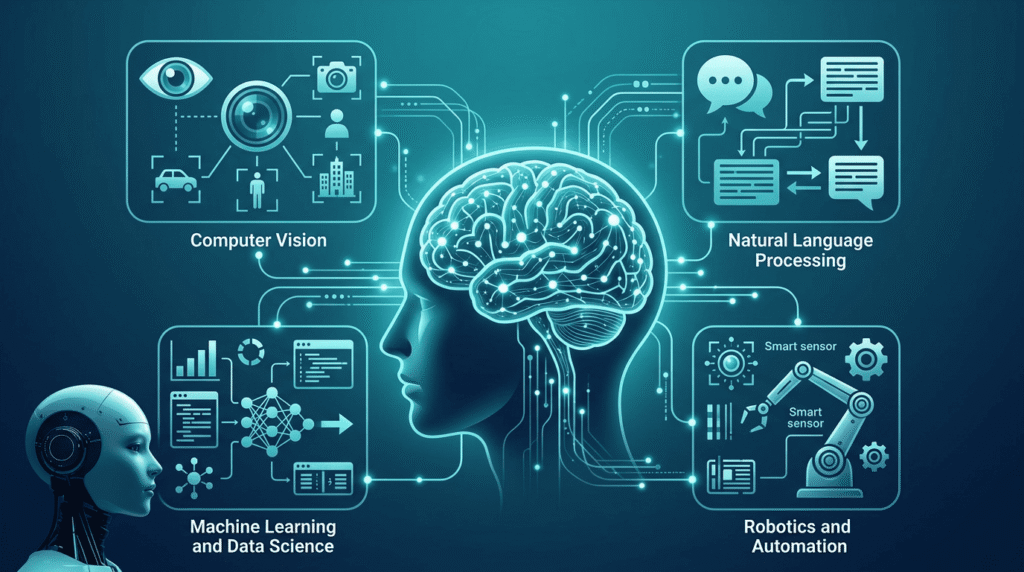
AI works by using data, algorithms, and computing power to identify patterns and make decisions or predictions. Traditional software follows fixed instructions written by programmers. For example, a simple program may follow the rule: if a user clicks this button, show this message. AI systems are different because they can learn from examples instead of relying only on manually written rules. This process is often called machine learning, which is one of the most important branches of artificial intelligence. In machine learning, a model is trained on data so it can recognize patterns and apply them to new situations. For example, if a model is trained on thousands of photos labeled as “cat” or “not cat,” it can learn visual features associated with cats and later identify cats in new images. A more advanced form of machine learning is deep learning, which uses artificial neural networks with many layers to process complex information. Deep learning has been especially successful in areas such as image recognition, speech recognition, natural language processing, and generative AI. Large language models, for instance, are trained on huge amounts of text and can generate human-like responses by predicting which words are likely to appear next based on context. Although this can produce impressive results, it is important to understand that AI output is based on statistical patterns rather than true human understanding.
Main Types of AI
Artificial intelligence can be described in several ways, but one common classification is narrow AI and general AI. Narrow AI, also known as weak AI, is designed to perform specific tasks. Almost all AI systems used today fall into this category. A facial recognition system can identify faces, a translation tool can translate text, and a recommendation algorithm can suggest products or videos, but these systems do not have broad human-like intelligence. They are powerful within limited areas but cannot independently understand every situation or transfer knowledge across all domains like a person can. General AI, also called artificial general intelligence or AGI, would be a system capable of learning, reasoning, and solving many different types of problems at a human level or beyond. At present, true AGI does not exist and remains a topic of research and debate. Another useful way to categorize AI is by function. Recognition AI identifies objects, speech, faces, or patterns. Predictive AI estimates future outcomes, such as customer demand, disease risk, or financial fraud. Generative AI creates new content, including articles, images, videos, audio, and software code. Decision-support AI helps people evaluate options, optimize processes, or manage complex systems. These categories often overlap, especially in modern AI products that combine multiple capabilities.
Common Applications of AI
AI is already part of daily life, even when people do not notice it. Search engines use artificial intelligence to understand user queries and rank relevant results. Social media platforms use AI to recommend posts, detect harmful content, and personalize feeds. Streaming services suggest movies and music based on previous behavior. Online stores use AI to recommend products, manage inventory, and improve customer experience. Banks use AI to detect unusual transactions and reduce fraud. In healthcare, AI can help analyze medical images, support diagnosis, predict patient risks, and assist drug discovery. In education, AI can provide personalized learning, language support, automated feedback, and study assistance. In manufacturing, AI is used for quality inspection, predictive maintenance, robotics, and supply chain optimization. In transportation, AI supports route planning, traffic prediction, driver assistance systems, and autonomous vehicle research. Businesses also use AI for customer service, marketing, sales forecasting, data analysis, document processing, and workflow automation. These applications show that AI is not limited to futuristic robots or science fiction. It is a practical technology that helps organizations process information faster, improve efficiency, reduce repetitive work, and provide more personalized services.
Benefits of Artificial Intelligence
The main benefit of AI is its ability to process large amounts of information quickly and identify patterns that may be difficult for humans to see. This makes it valuable in fields where speed, scale, and accuracy are important. In business, AI can improve productivity by automating repetitive tasks such as answering common customer questions, sorting documents, analyzing reports, or detecting errors. In healthcare, AI can support doctors by highlighting possible problems in scans or helping analyze patient data. In education, AI tools can adapt learning materials to individual students and make knowledge more accessible. In science, AI can help researchers analyze complex datasets, model climate patterns, study proteins, and accelerate discovery. AI can also improve accessibility through speech recognition, translation, text-to-speech, image description, and assistive technologies for people with disabilities. For consumers, AI can make digital services more convenient by improving search results, recommendations, navigation, and communication tools. However, the value of AI depends on how it is designed and used. A well-built AI system can save time, reduce costs, and support better decisions, but a poorly designed system can create errors, bias, or confusion.
Risks and Limitations of AI
Although AI has many advantages, it also has important risks and limitations. One major concern is accuracy. AI systems can make mistakes, especially when they are used outside the conditions they were trained for. Generative AI tools may produce information that sounds confident but is incorrect, outdated, or misleading. This is sometimes called hallucination. Another concern is bias. Because AI learns from data, it can reflect or amplify unfair patterns that already exist in society or in historical records. For example, if a hiring model is trained on biased employment data, it may produce unfair recommendations. Privacy is also a serious issue because AI systems often rely on large amounts of personal or behavioral data. Organizations must handle data responsibly, protect user information, and comply with privacy laws. Transparency is another challenge. Some advanced AI models are difficult to explain, making it hard to understand why they made a specific decision. This is especially important in areas such as healthcare, finance, insurance, employment, and law enforcement. AI can also be misused to create fake images, deepfake videos, spam, misinformation, or cyberattacks. These risks do not mean AI should be rejected, but they show why responsible development, regulation, human oversight, and ethical standards are necessary.
AI and the Future of Work
One of the most common questions about AI is whether it will replace human jobs. The answer is complex. AI will likely automate some tasks, especially repetitive, rule-based, and data-heavy work. Jobs involving basic data entry, routine customer service, simple content production, or standard document processing may change significantly. However, AI is also likely to support many workers rather than fully replace them. In many professions, AI can act as an assistant that helps people work faster and make better decisions. Writers can use AI for research and drafting, designers can use it for concept development, programmers can use it for code suggestions, and managers can use it for data analysis. Human skills such as critical thinking, creativity, emotional intelligence, leadership, ethical judgment, communication, and domain expertise remain important. The future of work will probably depend less on whether people compete with AI and more on whether they can use AI effectively. Workers and businesses that learn how to combine human judgment with AI tools may gain an advantage, while those who ignore technological change may face challenges.
The Future of AI
The future of artificial intelligence will likely involve more powerful models, broader industry adoption, better integration with everyday tools, and stronger rules around safety and ethics. AI systems are becoming more multimodal, meaning they can work with text, images, audio, video, and other types of data at the same time. This could improve applications in healthcare, education, design, robotics, customer service, and scientific research. At the same time, there will be growing attention to AI governance, data privacy, copyright, fairness, security, and accountability. Governments, companies, researchers, and civil society will need to work together to ensure AI is used responsibly. It is also important for ordinary users to understand both the strengths and weaknesses of AI. Artificial intelligence is not magic, and it is not a replacement for all human thinking. It is a powerful tool that can support productivity, creativity, research, and decision-making when used carefully. As AI continues to develop, the most valuable approach is to remain informed, verify important information, protect privacy, and use AI as a complement to human expertise rather than a substitute for it.